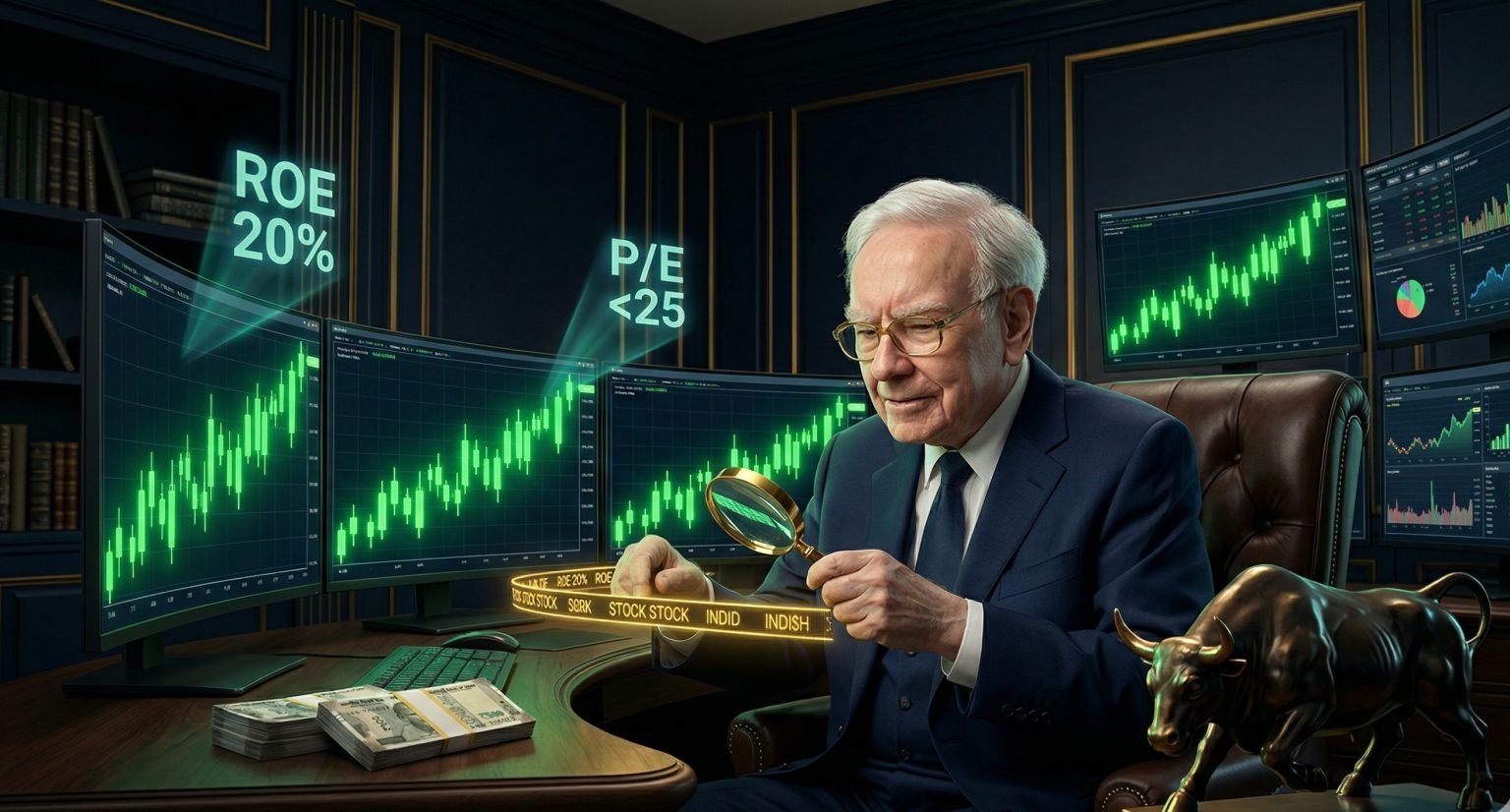
How to Screen Stocks Like Warren Buffett — A Guide for Indian Investors
TL;DR: Screen for ROE > 20%, gross margins > 40%, debt-to-equity < 0.5, P/E < 25, and consistent free cash flow. Then check for a moat. That's the Buffett formula in one sentence.
Most articles about "investing like Buffett" are vague. Buy great companies at fair prices. Sure. But what does that actually look like on a stock screener?
Buffett has been remarkably specific in his shareholder letters. Here are the exact numbers he uses, translated for Indian markets.
The Six Filters
Filter 1 — Return on Equity: 20%+ averaged over 10 years
This is Buffett's single most important metric. He wants businesses that compound shareholder capital at high rates consistently — not just in one great year.
His rule: average ROE above 20% over a decade, with no single year dipping below 15%.
How rare is that? Out of 1,000 large US companies studied across a decade, only 25 met this bar. In India, names like HDFC Bank, Bajaj Finance, and Asian Paints have historically cleared it. Most companies don't come close.
Filter 2 — Gross Margin: above 40%
Gross margin is the fingerprint of pricing power. If a company can charge 40%+ above its cost of goods and customers keep buying, something structural is protecting it.
The key isn't one year's number. Look at the trend across 5+ years. Is the margin stable? Rising? Or slowly eroding as competitors catch up?
Filter 3 — Debt-to-Equity: below 0.5
Buffett doesn't trust leverage. His reasoning: a company that needs debt to grow is a company whose economics aren't strong enough on their own.
D/E below 0.5 means the business funds most of its growth through retained earnings. In India, where repo rates swing between 4% and 8%, low-debt companies have a massive survival advantage during tight cycles.
Filter 4 — P/E Ratio: below 25
Even the best business is a bad investment at the wrong price. A trailing P/E under 25 is Buffett's ceiling — but this filter only works after the quality filters above. A low P/E on a bad business is a value trap, not a bargain.
Filter 5 — Free Cash Flow: positive for 5+ consecutive years
Buffett cares about "owner earnings" — what's left after maintaining the business. If reported profit is Rs. 100 crore but the company spends Rs. 90 crore on capex just to stay afloat, the owner gets Rs. 10 crore. That's the real number.
Look for companies where free cash flow tracks or exceeds net profit year after year.
Filter 6 — The Moat Question
This one can't be screened with numbers alone. Buffett looks for durable competitive advantages in five forms:
| Moat Type | What It Means | Indian Example |
|---|---|---|
| Brand power | Customers pay more out of loyalty | Titan, Asian Paints |
| Network effects | Product improves as users grow | BSE, PolicyBazaar |
| Switching costs | Painful for customers to leave | TCS enterprise contracts |
| Cost advantage | Produces cheaper than rivals | UltraTech Cement |
| Regulatory barrier | Licenses/approvals block entry | HDFC Bank's branch network |
If a stock passes filters 1–5 but has no identifiable moat, Buffett would pass.
Putting It Into Practice
Here's the exact checklist for screening Indian stocks:
- ROE > 20% (10-year average), no year below 15%
- Gross margin > 40% (stable or rising)
- Debt-to-equity < 0.5
- P/E (TTM) < 25
- Free cash flow positive for 5+ consecutive years
- At least one identifiable moat type
You can run these filters manually on Screener.in. Or build them as a reusable YAML strategy on StratVault — define once, run against live NSE/BSE data anytime the market moves. Several community-published Buffett screens already exist there if you want a starting point.